Wraps around the corner, stands without legs
The 270° awning covers the side of the vehicle and folds around the rear corner. That extra quadrant is where most camp kitchens end up — under the tailgate, out of the wind — and it is the reason this size outsells the straight 180° in overland builds.
It is a free-standing design. The frame holds itself out from the vehicle without a pair of legs planted in the ground, which means it can be deployed over a hard surface, over water, or on a pitch where you cannot drive stakes. Setting up and packing down is a single-person operation from the side of the vehicle.
Specification
Aluminium alloy frame, laminated PVC cover, 420D / 600D fabric with PU coating, grey or khaki. One two-layer door and three two-layer windows. Sizes from 200×200×200 to 300×300×200 cm with a 200 or 250 cm projection radius, packed in a PVC bag or an aluminium box.
What it pairs with
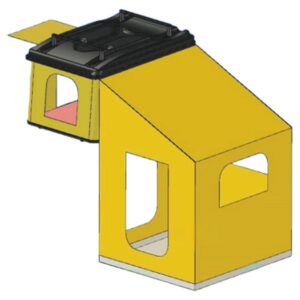
The awning room with PVC floor turns the covered area into a sleeping or storage space; the mosquito room does the same for insect-heavy markets; the car side shower tent mounts at the outer edge. On a 270° unit the room extends around the corner, which is what makes it usable as a second sleeping area rather than just shade.
Why free-standing matters commercially
It removes the most common objection to a large awning — that it needs guy lines and clear ground. A customer who parks on tarmac, gravel or a campsite hardstanding can still use the full footprint, and a rental operator does not have to train staff on staking.